Friday, September 24, 2010

Mean Streets

Every four weeks or so a few of us meet up for a fun ride around the city. The amount of actual riding can be variable, but we normally find some time to fit a few beers in as well - for carbo-loading purposes only of course. After all we are serious athletes.

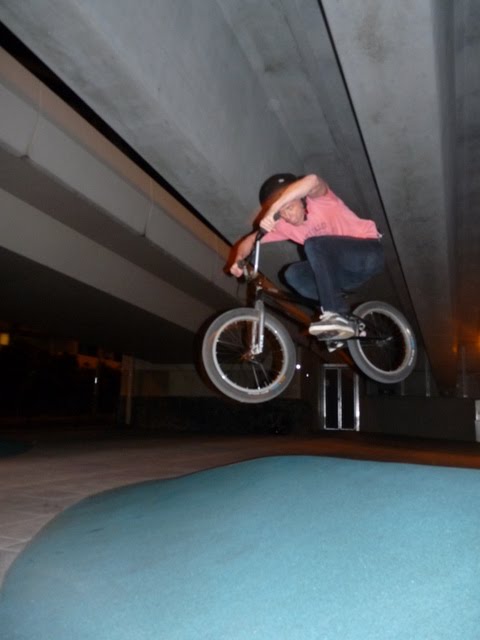
Last night we found a new spot - some wierdly soft rubber bulges installed under one of the new overpasses. Not really sure why they put them there but it's a fun piece of development. Nikko & Gareth took full advantage of them...


The camera was struggling a bit in the low light but I kind of like some of the images it produced...


After a quick drink or two the night ended with the traditional 'waterfront wheelie'
I've got to learn how to do that.

Tuesday, September 21, 2010

Self-righteously damp

My car was getting serviced today so I decided to ride in to work. Unfortunately the weather took a bad turn with persistent rain overnight continuing through the morning. I decided to man up, grabbed my rain jacket and loaded my bike into the car for the drive to the garage. I used to ride in the rain in the UK all the time - how hard can it be?

After unloading the bike and getting my riding gear on whilst sheltering under the awnings of the garage I thought twice about posting my keys through the 'out of office' slot. Then I thought about it a third time, and then a fourth. Finally I posted the keys and pedalled off into the downpour.

The first 5 minutes were horrible. My raincoat (a fetching orange waterproof breathable golf jacket I bought cheap in the US) was doing its job but my head, bum, legs and particularly my feet were getting progressively wetter. The water was dripping from my helmet visor & every puddle & every passing car made my socks squelch in my shoes a bit more. But after a while I realised I was as wet as I was going to get, stopped whineing and started to enjoy the ride.

I was also riding a new track to work as the garage was off of my usual route. I rode through the middle of Toohey Forest, some local woodland that I normally just ride next to. It was beautifully quiet on the footpath, the only sound being birdsong, the roll of my tyres and the splashing of the rain
The last time I rode past this spot it was at night, desperately chasing the tail-lights of two other guys on a hectic night ride. That night there were a number of gentleman standing around looking faintly dodgy and uncomfortable to be highlighted by our night-riding lights. Today I had the place to myself - just me & the rain.

Unfortunately the ride had to finish and I had to go to work. I squelched my way in to the office looking suave
Under Bicycle Queensland rules riding to work in the rain allows you to smugly utter glib platitudes such as 'there's no such thing as bad weather, just bad gear' and I took full advantage of that on my entrance. But after I'd showered I realised I had to ride back in the same gear that I wore on the way in, and it's hard to be too smug when you've had to try to dry your padded bike undies under a hand dryer.

Brisbane may be wet at times but it's never that cold and it's easy to ride with only a little discomfort. There are problems - the roads are slippy, you're more likely to puncture as thorns & bits of glass slide through the rubber of the tyre more easily, pedestrians are more worried about dodging puddles than watching for bikes and the Australian concept of 'safe driving' in the wet seems to be to tailgate and match speed with the guy in front so that the impact of the inevitable collision is reduced. But just like in the UK, once you knuckle down, accept that getting wet isn't going to kill you and just get on with it and then it's surprisingly enjoyable.

Sunday, September 19, 2010

Bottling day

No, not the beer I brewed up yesterday - it takes a bit more time than that! But the wheat beer has done its two weeks in the secondary fermentor so it's time to bottle it. I used to use large bottled water containers to bottle my beer but it looked terrible and was never very effective - plus it meant I had to drink the beer 5 litres at a time. So this time I splashed out on some flip-top glass bottles.

Sampling the young beer is a perk of brewing and it was interesting tasting the beers that were conditioned in different ways. The orange peel & coriander didn't really taste of much - its taste was even cleaner taste than the demijohns without any extra additives. The hopped batch had the best 'foretaste', but it was still pretty bland. Hopefully a couple of weeks in the bottle will help, but to be fair all I did was mix a brew kit so I shouldn't be hoping for too much.
The Witches Brew is looking very happy with a nice fluffy yeast head and plentiful bubbling from the airlock
I think I know why the sugar yield was low though - the hot water I used in the mash process was used to heat up the esky as well as the grain, and this probably took a good4 or 5 degrees away. Next time I'll pre-heat the esky with near-boiling water as well.
Saying that it's important in homebrew to pace yourself & not get too carried away. I have 4 gallons of wheat beer in 24 bottles that needs to sit for at least two weeks, and 4 gallons of Witches Brew that will need to be racked off in a week and will be ready for bottling a couple of weeks later. That's a lot of beer and a lot of bottles. I have some really interesting recipes I want to try (eg proper ginger beer from a ginger beer plant, watermelon wheat beer & gruit beer) as well as working on getting a better sugar yield with some of the other real beer recipes. But unless I want to bury myself in bottles I need to relax and let the existing beer mature. In time a natural cycle should develop.

Saturday, September 18, 2010

Partial Mash

Beer in its purest form is the fermentation of sugars extracted from barley. In fact the word beer is thought to originate from 'baerlic', the Old English word for barley. The barley is allowed to germinate and then the germination is halted and the barley is kilned. The result - malted barley - is chock full of the sugary goodness that nature intended to use to power the growth of the barley. This extraction of the malt is one of the dark arts of brewing, the process further muddied by the use of words such as mashing & sparging to describe what are in reality quite simple processes.

I've always shied away from using real grains in my brewing, prefering to use kits with pre-extracted & flavoured malt in a can or mucking around with various fruits & vegetables. It's a lot easier to attempt to make potato & carrot beer or dandelion beer as you don't really know what it will taste like at the end. That means it's hard to fail - you produce a gallon or so of a dry drink tasting vaguely of whatever you boiled up in the brewpot. You may not like the taste - and most of my friends generally didn't! -but that's a matter of taste.

Recently I've been tempted down the grain route. It's hard to produce a reasonable size brew entirely from grain as it needs a fair bit of liquid which means you have to have space, large pots & pans and a sturdy cooker. There is an alternative though - you can make half of the 'wort' (the unfermented beer solution) from grain and add in liquid malt extract for the rest. This gives you a lot more control over the flavours that come through in the beer than using a standard kit, but also means that you can brew a batch in an apartment. This is called a 'partial mash' or a 'mini-mash'.

I'm trying a partial mash version of a recipe for Pendle Witches Brew, a favourite drink of mine from back in the UK. The first thing to do is get your ingredients together - the recipe uses 2 kg of 'traditional' malted barley and 250g of crystal malt to provide the grain sugars
These grains are 'mashed' - ie soaked in water kept at around 66 degrees Centigrade for 90 minutes to allow the sugars to seep out. To make this process easier I'm using a grain bag (essentially a large tea bag) inside a large Esky
The water temperature is fairly critical. The grains will cool the water down when it is added so you need to heat the water up to a few more degrees than the intended mashing temperature. A rule of thumb is 6 degrees higher than mashing temperature
However as I'm adding the water to the mashing container instead of heating it up 'in situ' I lost a bit more temperature heating up the inside of the Esky and only got 65 degrees. Never mind - lesson learnt, I'll know to use an initial temperature of 74 degrees next time.
After you add the water give the bag some vigouros poking to make sure there are no dry clumps of grain inside the bag. Also be careful not to let the bag fall into the water, else you get the grains escaping like in the picture above.

Now comes the hard part - leave it for 90 mins and resist the urge to look at it, because every time you lift that lid you lose temperature. I'd love to say that I spent the time doing manly things like drinking beer & watching sports but I ended up tidying the flat, doing the hoovering & watering the plants.

After an hour & a half you can take a look at your mash. The temperature in mine had dropped to 62 degrees (I think I peeked too many times) but although this isn't great I think it just means I don't extract the optimal amount of sugars from the barley. However, even after the mash is completed there are still more sugars to be retreived. So first off pull the grain bag out and let it drain as much as possible
(Mmmmm - beer)
Next move the bag over to a large pot containing water at around 80 degrees that you prepared earlier

Soak the bag of grain for 10-15 minutes and you'll pull out a lot more of the remaining sugars, like a Yorkshireman reusing a teabag. This secondary extraction step is called sparging - it's normally done by trickling hot water over the grains but this way is a lot easier.
Make sure you drain the bag thoroughly at the end of the sparge - a handy spoon can help if you're tired of holding bags of grain above hot pans of water
Tip the wort from the Esky into the pot. The Original Gravity of my wort (a measure of the sugar content and hence the eventual alcohol content) was around 1030 at this point.
Next comes the boil. At this point you add any extras specified in the recipe - I added some canned malt (to bring the OG up a bit) and also some 'torrified wheat'. Turns out this was a breakfast cereal, which felt a bit wierd
and made it look like a porridge
Once the mixture comes to the boil (which takes a surprisingly long time on a cheap stove) add in any hops (I'm using Fuggles hops in the recipe) and vigorously boil it for 90 minutes. You may also need to add extras into the brew at nominated times - my recipe had me adding white sugar halfway through the boil, which is unusual as sugar is generally considered 'cheating' in home brew. I think it's a way of bringing up the strength of the beer whilst keeping a lighter taste.
You also need to add some more hops 15 minutes from the end of the boil - these are more for the smell of the beer than the taste. Speaking of which, your flat will now smell of a lovely mix of malty sugars with a hoppy nose. It's good to live somewhere warm so you can leave the doors open, and a patient partner is also a must. Thanks Liz.
Once the boil is over it's homebrew business as normal. Cool the wort down

then load it into the fermentor, The whole process of partial mashing took about 5 hrs in all, although a lot of it was waiting for things to steep or boil and you can get on with other things. It gave me around 10l of wonderfully smelling wort with a gravity of around 1100 - this is huge, stronger than the OG of a lot of wines. I added another 10l or so of water to bring the OG down to 1040 (which will give a roughly 5% alcohol beer - weaker than the recipe indicates, which is probably because I didn't pull all the sugars out of the barley), and once everything cooled down I chucked in (or 'pitched') the yeast. I'm using dried yeast but I've rejuvinated it in warm sugary water so it should be good & hungry & happy to be introduced to the wort.
Now it's just a question of waiting, and hoping that the end brew is worth the work!

Tuesday, September 14, 2010

Rack Off!

Whilst we're on the home front, I've also racked off my wheat beer
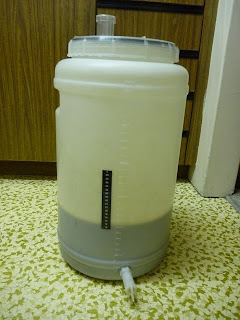
Racking the beer takes it off the initial fermentation mulch and gives it some time to clear and for the more subtle stages of secondary fermentation to take place. I'm using 4 separate gallon demijohns to hold the beer and I'm experimenting with a couple of additives. Two are straight out of the fermenter, one is laced with hops to give it more of an aroma and one contains a combination of orange peel & crushed coriander seed in a cheesecloth bag. I'll bottle them in a week or so and a fortnight after that I get to taste the differences.

A friend has lent me a book on brewing classic British beers using malted barley & fresh hops so now I'm looking forward to getting into the arcane world of mashing, sparging, tunning and the like. I've always avoided the more 'beardy' end of homebrew, preferring to dabble with kit brews and experimenting by fermenting various fruits & vegetables with sugar, but I think it's time to up my game. It will be a challenge given our small flat but I have a few hints & tips to make it easier. But until I visit the homebrew shop I can only flick longingly through the recipes and dream. You have to love a book that has an 8 page chapter on yeast- well as long as it's not a medical text book.

Courgette Liberation Front

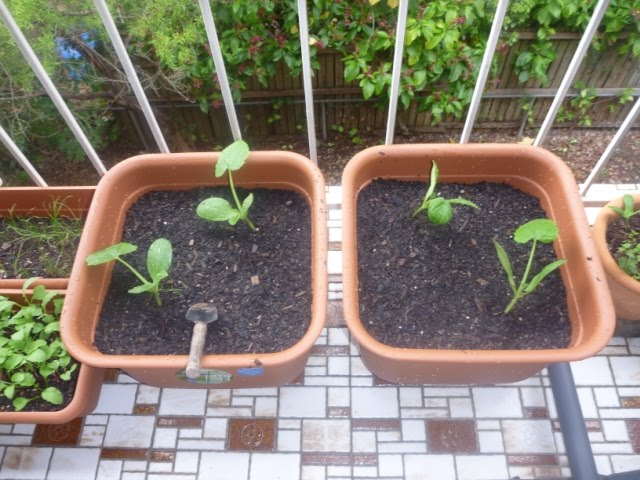
There's been a few comments about the inhumane conditions that my courgettes have been born into. I've been shamed into action and last weekend there was some much-needed repotting. Some of the pots will still be a little small - I like to think of them as Bonsai Zucchini - but hopefully this will give them enough room to stretch their roots


I even planted one free-range downstairs - hopefully it won't end up as food for the local wildlife...

Sunday, September 12, 2010

Riverfire

Brisbane has an annual fireworks display called Riverfire. It's a huge display with 6 floating barges on the river launching fireworks synchronised to music played on one of the local radio stations, and more fireworks hanging off every bridge and a lot of the tall buildings in the CBD. Something like 65,000 separate fireworks are launched over the time of the display. This takes place in early September and attracts huge crowds - I rode past at 10am this year & there were people staking out prime areas for the display at 7pm that night
There is a fair degree of ingenuity in some spots, with hammocks strung from poles, tarpaulins covering picnic spots and beer filled eskies. Other people simply set up camp chairs and sit there from early in the morning until early evening. It was a squally wet day this year so that can't have been much fun. We normally get the bus down to the river for Riverfire but this year we decided we'd stay home and watch it from the balcony.
The display starts with two Royal Australian Air Force F-111s doing a 'dump & burn'. This is the air force equivalent of doing do-nuts in a ute in the carpark. The F-111 comes in low & fast, pulls up, dumps fuel and ignites its afterburners. This creates an awesome tail of flame that lights up the sky as the plane climbs.
Dodgy picture - better to watch this or look up 'dump & burn' on you-tube. It's apparently a specialisation of the Australian Air Force and one that won't be repeated as the planes are being replaced this year. It's a thrilling thing to watch in person - the plane can come in so low that you flinch from the light & feel the heat of the burn before you hear the plane roaring over your head.

Once the planes have done their stuff the fireworks kick off. The firework display is literally 25 minutes long - long enough for you to get excited about it, get a bit bored, grab a fresh beer and then get exited all over again. The entire city lights up, and although I have no decent pictures from this year the web can supply plenty of examples like this

The display ends with another dump & burn. This year there were two at the end - although I know these things are meticulously choreographed I still like to think that the pilots thought 'yeah - what the hell, we've got enough fuel. Let's just do it one more time'.

There's also plenty of video out there , but the best thing to do is come & check it out next year. Bring your own chair & be sure to get there early...